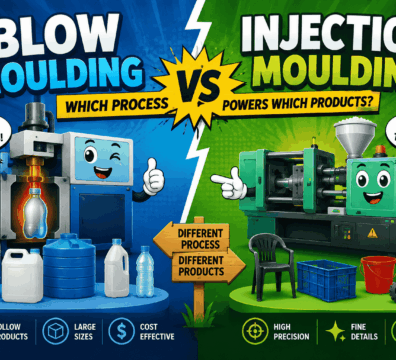
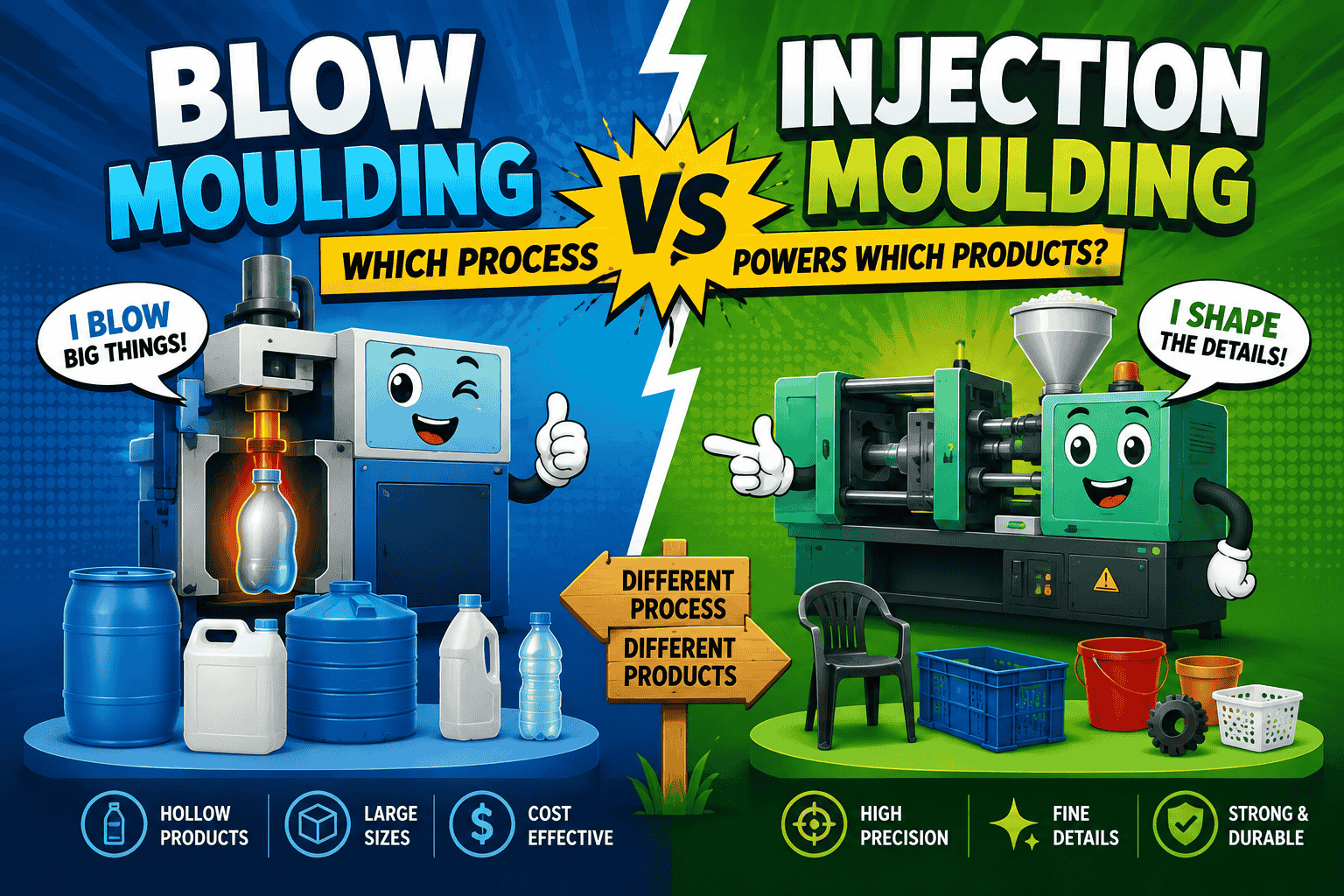
Two machines, two processes- But the goal is the same – precision. However, the choice is determined by the details needed. Blow molding and injection molding both mold thermoplastics used for forming products. However, both the processes are different and have distinct applications. The process choice depends on aspects such as the product design, wall thickness, strength, production volume, material and tooling cost.
Each molding process has its strengths and thus suits the product range of hollow bottles and containers to complex automotive and industrial components. With extensive experience in both processes at Mitsu Chem, this article exposes major differences between blow molding and injection molding. Also, it helps identify the process that suits different products.
What is Blow Molding?
Blow molding is a manufacturing process used to make hollow plastic products by inflating a tube of heated plastic (a parison) inside a mold with compressed air. The process begins with the plastic being heated and formed into a tube (parison). Next, the machine places the parison into the mold and seals it, then compressed air expands the plastic to conform to the mold walls. The material cools down and assumes the shape. In case additional finishing is required, excess material is trimmed, and other necessary operations are performed.
Blow molding is especially effective for hollow structures, uniform wall thicknesses, lightweight constructions and durability. This process can produce numerous products.
Some of them are:
- Plastic bottles and containers
- Industrial packaging
- Water and storage tanks
- Automotive components
- Household containers
- Hospital Furniture Parts
- Large hollow plastic products
Mitsu Chem manufactures a variety of molded industrial packaging and customized plastic products using blow molding, depending on specific application requirements. Material selection, product dimensions, mold design and use determine the manufacturing process.
What is Injection Molding?
Injection molding is a manufacturing process for producing parts by injecting material into a mold. The plastic material is heated and injected into the cavity of a mold.
The plastic solidifies in the mold taking the final shape. After the stipulated time, the mold is opened, and the product is ejected.
Injection molding is most appropriate for products which require detailed shapes, dimensional accuracy, strength and consistent production.
Below are typical products which are produced using the injection molding process:
- Automotive components
- Healthcare products
- Furniture components / Accessories
- Industrial parts
- Container Caps, Closures, Plugs, etc.
- Electrical housings
- Customized plastic components
Mitsu Chem applies injection molding capabilities across several product categories, including complex packaging accessories (Caps, Lids, Plugs, Handles), automotive components, healthcare furniture accessories.
Blow Moulding vs Injection Moulding: Major Differences
The key difference between the two processes is related to how they form plastic. Below is a quick overview:
Feature | Blow Moulding | Injection Moulding |
Product structure | Mainly hollow | Mainly solid |
Best suited for | Bottles, containers, tanks, packaging | Complex, Detailed and structural components (Caps, Handles, Casing/Housings) |
Formation method | Air expands softened plastic | Pressure fills the mould cavity with molten plastic |
Wall design | Generally thin and hollow | Solid or highly detailed |
Tooling cost | Generally lower | Generally higher |
Design detail | Suitable for simpler hollow forms | Suitable for complex geometries |
Production volume | High | High to very high |
Common materials | HDPE, PET, PP, LDPE | PP, ABS, PC, Nylon, TPE |
How Does Mitsu Chem Choose the Right Moulding Process?
The right choice starts with understanding the product rather than with choosing a manufacturing process. At Mitsu Chem, we consider the products’ purpose, size, material & structural requirements, production volume and customer specifications before selecting the most suitable molding approach.
- We know the blow molding process is most suitable for products that require hollow structures and lightweight construction for packaging or storage goods. Therefore, it is used for a variety of industrial packaging and customized products.
- Injection molding is best applicable for components that require complex geometry, dimensional accuracy, detailed surfaces, and strength. It is therefore most appropriate for automotive, healthcare, furniture and industrial applications.
In case of specific requirements, customized moulding would be considered.
Conclusion
Manufacturing processes have various requirements. Therefore, the right process depends on the product, material, application, production requirements and needed performance. With extensive experience in blow moulding and injection moulding, Mitsu Chem offers customized plastic manufacturing solutions for industrial, automotive, healthcare, and infrastructure applications.
From product requirements to final manufacturing, Mitsu Chem combines decades of manufacturing experience to help its customers manufacture plastic products according to their needs.